Friday, 10 April 2015

Blogging from A to Z in April - The Letter I - Friday April 10th, 2015


<a href="http://www.a-to-zchallenge.com/"><img alt="" src="http://i1139.photobucket.com/albums/n547/Jeremy-iZombie/A2Z-BADGE-0002015-LifeisGood-230_zps660c38a0.jpg" title="Blogging from A to Z April Challenge" /></a>


Friday April 10th, 2015 - The Letter I.


I is for Igelkott, which is the Swedish word for Hedgehog.


source


I think hedgehogs are adorable little animals, but they are not fluffy, furry, cuddly animals. They have spiny quills all over their backs. 


source


They curl up into a spiny ball when they feel threatened. Here is a map of where hedges live in Europe.


source


The first time I saw a hedgehog was when I went to live with my Mormor  (=maternal grandmother, literally 'mother's mother; as you have already learned from Tina Downey's Swedish lessons from A to Z in 2012; check out her lesson 'Far' here from 6th April 2012. ) when I was seventeen years old. My Morfar (=maternal grandfather) had passed away two years earlier. She moved from a huge house in the big city - Stockholm - to a small town, Arboga, and lived in a small cottage on a forest-covered hill, and a garden with strawberry plants. Mormor's garden was frequently visited by hedgehogs.


source


In the early mornings we could see them near the edge of the bushes in her garden. We gave them milk in a saucer (even though they actually prefer to eat earthworms and insects).


source


Many years later, when I was having my ups and downs financially and had to take all kinds of odd jobs to make ends meet, I worked for a few weeks delivering daily newspapers. I would go out at one am and work until sunrise wheeling a cart full of Dagens Nyheter and Svenska Dagbladet, running up and down the stairs of garden apartment houses in a suburb of Stockholm. It was quiet, and I could see hares running across the green and wooded park areas between the dwellings. It was May. A good time to work the night-shift outdoors. The smell of fresh air and spring with everything starting to bloom: trees, grass, flowers. In every other tree there were nests filled with families of birds chirping as the sky grew pale. And there, between running in and out of doors, stuffing papers into mail-slots getting my hands and clothes blackened and sooty-looking papers from the printing-ink, these pairs of hedgehogs - and they were courting! A male hedgehog circling around a female. They did a little hedgehog-dance about hedgehog-love.

I was not very happy at that time. But seeing these little spiny creatures reminded me of happier times with Mormor and gave me hope for the future. They are not cuddly, but loveable in their own thorny way.


source


It's soon the right time of year to find my prickly friends. I think I'll take a walk through the woods at dawn tomorrow.

Best wishes,
Anna


First Commenter:
Geoff Maritz

Geoff's Blogs


http://geoffmaritz.blogspot.se/


P.S.

Do you want to know what a hedgehog sounds like? Click here and then click on the image that looks like this:
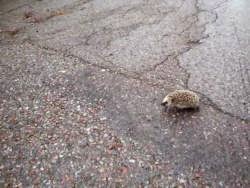


http://commons.wikimedia.org/wiki/File:Young_Erinaceus_europaeus_calling.ogv


Or click here.

Thursday, 9 April 2015

Blogging from A to Z in April - The Letter H - Thursday 9th April 2015


<a href="http://www.a-to-zchallenge.com/"><img alt="" src="http://i1139.photobucket.com/albums/n547/Jeremy-iZombie/A2Z-BADGE-0002015-LifeisGood-230_zps660c38a0.jpg" title="Blogging from A to Z April Challenge" /></a>


Thursday 9th April 2015 - The Letter H.


H is for Heart, which is Hjärta in Swedish.

Here is an example of why spelling-reformers should be careful and think twice about enforcing only phonetic spelling. The 'H' in hjärta is silent. But since it's still there as a natural part of this everyday word, it is easy to see the relationship between the Swedish word hjärta and its equivalents in other related languages such as English. A quick look at the word 'heart' in several modern European languages reveals their common Germanic origin: 'heart' is Herz in German, hart in Dutch, hjerte in Norwegian, hjerte i Danish, and hjarta in Icelandic.

'Heart' in the romance, Latin-based languages is cœur in French, cuore in Italian and corazón in Spanish. (Cor is 'heart' in Latin.)

If we look at examples of modern European languages that are not considered to be Indo-European, 'heart' looks very different. 'Heart' is sydän in Finnish, süda in Estonian and szív in Hungarian.

 Looking at other languages around the Baltic Sea, 'heart' is širdis in Lithuanian, sirds in Latvian, and serce in Polish (and srdeční in its closest neighbouring language, Czech). 

In a very different language with its roots in the old world of the Celts, 'heart' is y galon in Welsh.*

 ---

Whew! Enough is enough! 

Why did I choose the word 'heart'?

Because I am always thinking about hearts. My daughter was born with a minor heart defect and had to have open-heart surgery when she was only one week old. She's doing fine now. They check her heart every other year. But in the back of my mind, I am always wondering, 'Will she continue to do well in the future? Will she be able to live a full life? Will she outlive me, as is nature's course?'


No one knows. But the nurse at the hospital that did the procedure, told us to let her live like any normal child. So today, I am with her counting how may hops she does when she is skipping rope or checking my stop-watch to see how long she can keep her hula-hoop going or how fast she can run around the courtyard where we live.


Elisabet showing off the chocolate cake she made herself.


I'm happy as long as she's happy and healthy.


Thank you for visiting. 

Best wishes,
Anna


First Commenter:

Geoff Maritz

Geoff's Blogs 

http://geoffmaritz.blogspot.se/


* Disclaimer: I do not know all of these languages. I am familiar with the Scandinavian languages, English, German and French. But I used Google's translating tool to find most of these words. Please correct me if I am wrong. I only used languages with the Roman alphabet. Sorry.

Wednesday, 8 April 2015

Blogging from A to Z in April - The Letter G - Wednesday 8th April 2015


<a href="http://www.a-to-zchallenge.com/"><img alt="" src="http://i1139.photobucket.com/albums/n547/Jeremy-iZombie/A2Z-BADGE-0002015-LifeisGood-230_zps660c38a0.jpg" title="Blogging from A to Z April Challenge" /></a>


 Wednesday, 8th April 2015 - The Letter G.


G as in Gris, which is the Swedish word for Pig!


source


Yes, I know. You are wondering why I want to write about a Swedish word that means 'pig'. Well, in Sweden, pigs are actually very well-liked. I mean, we consume a lot of pork and ham in Sweden. We don't have turkey for Christmas dinner, as you do in the United States. You serve smoked ham for Christmas. But besides pigs as a source of meat, they are actually very cute, especially baby pigs. 


But if I continue along this line, I will end up as a vegetarian!


source


Aren't they just too cute to eat?


What got me to choose the Swedish word for 'pig': 'gris' [looks like the French word for the colour 'gray' but sounds like the word for 'fat-left-in-the-frying-pan', 'grease', except with a Swedish, slightly rolling, 'r' (think of a Scottish 'r') and an unvoiced 's'] is a Swedish song about how we all are our mothers' little pigs, keeps buzzing in my head:


Morsgrisar är vi allihopa, allihopa, allihopa.
Morsgrisar är vi allihopa, allihopa, ja mä’.
Ja mä’, å du mä’. Ja mä’ och du mä’.


Source: http://www.julsånger.se/sanglekar/morsgrisar-ar-vi-allihopa/

There is also a word for someone who is a favourite, spoiled and doted upon: 'kelgris', which means approximately 'cuddle-pig'.


source


Thanks for visiting.

Best wishes,
Anna


P.S.
Did you know that some pigs can swim?


source


More about pigs (in Swedish) here.


First Commenter:
Alex J. Cavanaugh


http://alexjcavanaugh.blogspot.se/2015/04/a-to-z-challenge-g-cult-classics-galaxy.html

Translate a text here: